The Ultimate Guide to Buying or Renting a Violin
How to buy a violin?
Embarking on the journey to acquire a violin is an exciting venture, whether you’re a beginner, an intermediate player, or a seasoned musician looking to upgrade. Here’s a comprehensive guide to help you navigate the process of buying or renting a violin.
1. Determine Your Skill Level and Budget
Before diving into the specifics, it’s crucial to assess your current skill level and set a realistic budget. Violins can range from affordable beginner models to high-end professional instruments costing thousands of dollars.
- Beginner Violin: Typically ranges from $100 to $500. Ideal for those just starting out.
- Intermediate Violin: Priced between $500 and $5,000. Suitable for advancing students who need better sound quality and playability.
- Professional Violin: Starts from $5,000 and can go up to several tens of thousands. These are crafted from high-quality materials and offer superior sound.
2. Consider Renting a Violin
In Bamboo Music Academy we work together with the renamed violinmaker Niklaus Weber, that offers us the best relation quality-price for a price of only around 20€/month.

Renting a violin can be an excellent option for beginners and children, offering flexibility and cost savings. Renting allows you to save money for lessons and other essential accessories. It’s a cost-effective way to start your musical journey without a significant upfront investment.
As kids grow, they need different violin sizes. Renting ensures they always have the right size without the hassle of frequently buying new instruments.
When the kid it is old enough to use a full size violin and it is really committed as a long term goal, I think it is the moment to start thinking about buying a violin.
3. Understand the Violin Sizes
Do you imagine using shoes that are not your size? With the violins it is quite the same.
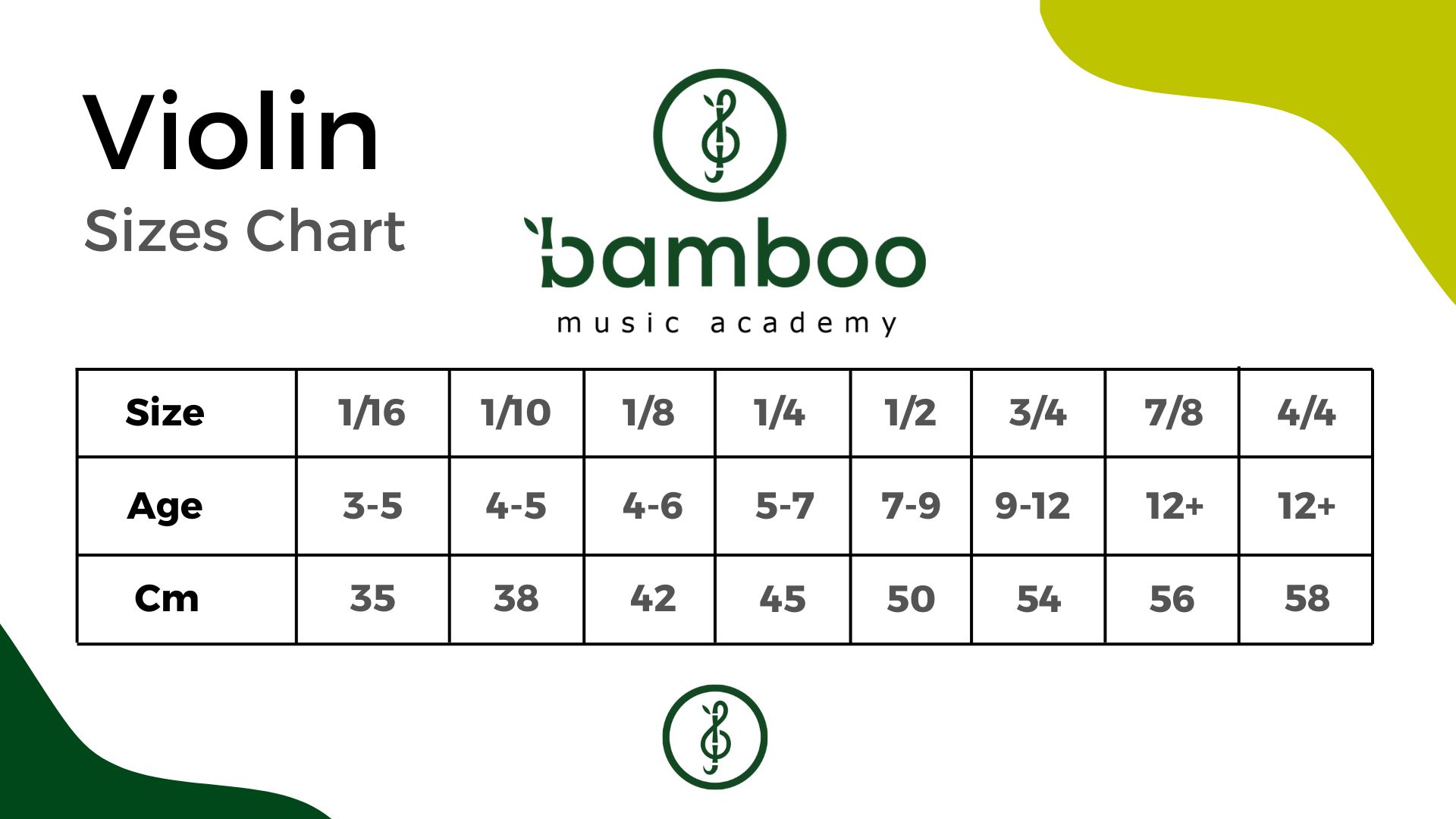
Violins come in various sizes to accommodate different age groups. This is a crucial fact, because using the incorrect size can cause problems in the learning process as well as in the health.
- 4/4 (Full Size): Suitable for adults and older children with a fully developed arm length.
- 3/4, 1/2, 1/4, 1/8, 1/10, 1/16 Sizes: These fractional sizes are designed for younger children. The smaller the fraction, the smaller the violin. You can consult the following chart to determine the right size for your child.

A good tip to know if the violin is the proper size for you is to hold the screw of the violin with the hand and observe if the elbow is curved. If it is straight the violin might be too big for us.

4. Try Before You Buy
Playing the violin before purchasing is essential. Here’s what to look for:
- Sound Quality: Pay attention to the instrument’s tone. It should be clear, warm, and consistent across all strings.
- Playability: Ensure the violin feels comfortable in your hands, and the action (the distance between the strings and the fingerboard) is appropriate.
- Condition: Check for any visible cracks, seams, or signs of wear. A well-maintained violin will last longer and perform better.
5. Seek Professional Advice
Consulting with a violin teacher, luthier, or experienced violinist can provide invaluable insights. They can help you evaluate the instrument’s quality and suitability for your needs.
Also you should ask different professionals, in this world there are a lots of scammers that will try to sell you a really expensive violin that actually it is not that good.
Conclusion
Whether you decide to buy or rent a violin, it’s a significant investment in your musical journey. By understanding your needs, trying various instruments, and seeking professional guidance, you can find a violin that will inspire and support your growth as a musician. Renting can be a smart, flexible choice, especially for beginners and children, allowing you to save on initial costs and ensure you have the right size instrument as you progress.
Happy playing!